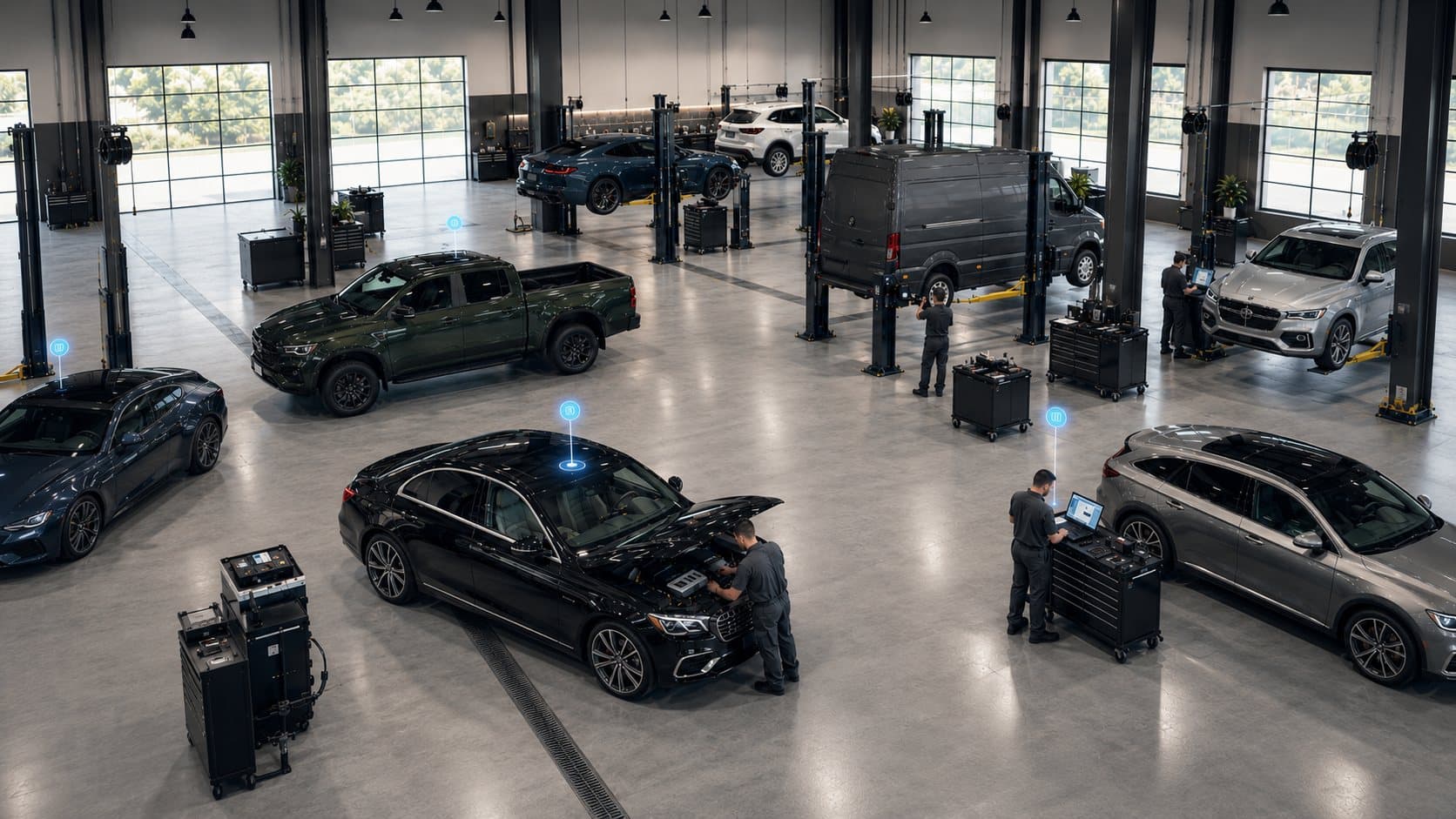
The Shop Your DMS Cannot See
Every dealership has a DMS. It manages service orders, parts, billing. It is the business management system.
But there is a question the DMS cannot answer: where is the customer's vehicle physically right now, and how long has it been sitting untouched?
Between check-in and delivery, a vehicle lives a physical journey: reception, diagnosis, waiting for parts, bay, testing, wash, delivery. The DMS records the administrative milestones. The real journey (with its waits, detours and idle time) is invisible. And in that invisible journey hides the revenue your shop is letting go.
What Is Physical Workshop Traceability?
It is the automatic record of each vehicle's complete trip through the facility:
- Check-in: what time the vehicle entered, without depending on anyone typing it
- Diagnosis: when it actually started and how long it really took
- Bay and technician: which bay it was in, with whom, and for how long
- Waits: how long the vehicle sat idle between stages
- Delivery: the full cycle, door to door, with exact timestamps
This is how Lyna Dealers, the AI workshop traceability solution, works: it does not touch your DMS, it powers it up with the physical layer that does not exist today.
The Three Numbers That Change a Shop
1. Bay turnover
How many vehicles does each bay handle per day? When measured, the typical pattern appears immediately: two bays saturated, two bays barely working. Balancing that load is free capacity: more vehicles served with the same bays and the same staff.
2. Time per stage
A vehicle's cycle is rarely lost in the repair itself: it is lost in the waits between stages. Measuring how long a vehicle waits between diagnosis and bay, or between repair and wash, points exactly to where the flow gets stuck.
3. Productive hours per technician
Not to surveil: to assign better. Knowing which areas concentrate the work and which technicians are saturated lets you distribute the load and plan shifts with facts.
What Does the End Customer Get?
Traceability does not just organize the shop internally. It changes the conversation with the customer:
- Delivery dates backed by data: you promise based on real times, not optimism
- Early notice: if a stage slips, you know before the customer does
- Answers with certainty: "your vehicle has been in repair since 10:40" instead of "let me check"
- A complete history: every vehicle has its own timeline, useful for any claim or clarification
In a market where after-sales service defines brand loyalty, certainty is a differentiator customers can feel.
How Is It Implemented?
Without stopping the shop and without changing your systems:
- Mapping: your shop's real stages and zones are defined (reception, diagnosis, bays, wash, delivery)
- Automatic detection: the platform records each vehicle's passage through every stage, with exact times
- Live board: the shop manager sees the complete flow and alerts for stalled vehicles
- AI on top of the data: within the first weeks, the platform highlights patterns: unbalanced bays, recurring waits, peak hours
The DMS keeps doing its job. Physical traceability gives it the eyes it was missing.
The Question That Matters
How many more vehicles could your shop handle if every bay worked evenly and every invisible wait became visible?
In most shops, the answer is not building more bays or hiring more technicians. It is seeing, for the first time, what already happens inside.